Home / Thirty changes / One part of the shape changed / The Burren and south Connemara
House shape, hire car removed
Limestone, one base and nobody handing you keys, because you book eight nights in the Burren with a driver
The part that breaks here is the hire car. Eight nights hold; one base holds; out every day and back to the same bed holds. What replaces the car is a driver with a car of their own, for six of the eight days. You book eight nights in the Burren with a driver from $3,140 for two, roughly eight hundred dollars above the house shape.
| What it breaks | a driver instead of a hire car |
|---|---|
| Nights | 8 instead of 8 |
| Places you sleep | 1 |
| Car | no hire car |
| From where you land | 2 hours |
| Season | shoulder |
| People the figure is built on | 2 |
| How far from the shape | one part changed |
| Two sharing pay | from $3,140 |
What comes out, and what goes in its place
The hire car is the part that comes out. Everything around it holds: eight nights, one base you unpack into on the first evening and leave on the last morning, out every day and back to the same bed, shoulder season, two people. In place of the car there is a driver with a car of their own, booked for six of the eight days at about nine hours a day, waiting time included. That is where the difference sits. From $3,140 for two against the house figure of $2,340, for the same nights in the same weeks. Spread across six driven days the change works out near $133 a day, which covers the vehicle, the fuel, the parking, and somebody who knows that the lay-by at the portal tomb is full by eleven and empty again by four. Money does not move through this office at any stage. The guesthouse settles with you at its own desk; the driving service sends its own bill at the end of the week. What we are paid arrives afterwards and comes from the suppliers, not from you, and we take no card details to hold a booking or for any other purpose.
Limestone, and the roads laid across it
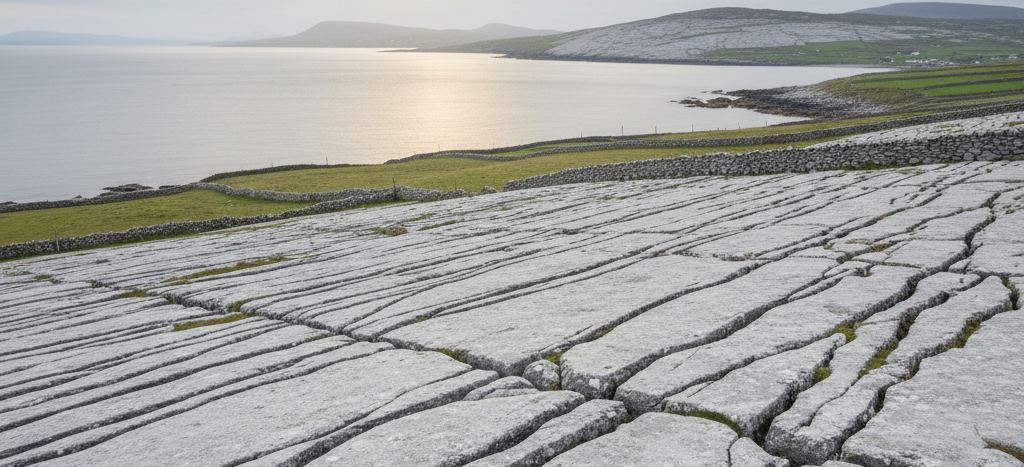
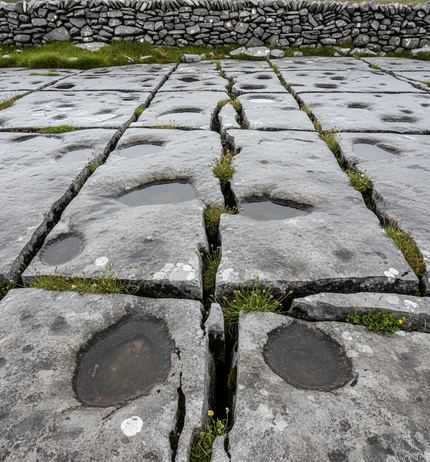
The Burren is about 250 square kilometres of bare karst in north County Clare: limestone laid down flat, lifted, then split into slabs with fissures between them. It is easy to underestimate on foot. The fissures are ankle deep and often ankle wide, they run in two directions at once, and for an hour after rain the top of every slab is slick. The roads are the other half of it. The coast road round Black Head, the R477, is wide and open and does what a coast road should. Almost everything else sits on the small roads inland: three metres of tarmac, a green stripe down the centre, dry stone wall on both shoulders and nothing behind the wall that gives. Passing means one car reversing, sometimes two hundred metres, sometimes uphill, sometimes into a gateway you have to trust is where you remember it. Corkscrew Hill on the N67, cut in the 1840s, climbs out of Ballyvaughan in a stack of hairpins with the drop on the outside. It is all drivable. It is also tiring in a way that quietly eats the afternoon, and by the fourth day people start choosing the near stop over the far one without noticing they are doing it.
South Connemara, and what distance does to a day
South Connemara begins about forty minutes west of the base and then keeps going for longer than the map suggests. The R336 runs along the north shore of Galway Bay through Spiddal and out towards Rossaveal. West of that the ground breaks into low bog, bare granite and sea inlets, and the road south to Carraroe, Lettermore and Lettermullen crosses causeways between islands that do not read as islands from inside a car. The numbers are the point. Galway to Carraroe is 40 km and takes an hour, because the road bends round every inlet instead of crossing it. Roundstone is 77 km and closer to an hour and twenty. So a Connemara day carries two and a half to three hours of driving before anything else happens at all, and on this shape the driver absorbs every minute of it while you look out at bog cotton, turf banks and granite. The strand at Carraroe is the standard stop, and the pale grains underfoot are crushed calcified seaweed rather than coral, whatever the English name has settled on. Irish is the working language in these villages, used in the shops and at the fuel pumps; English is answered without fuss and is plainly the second choice.
Six driven days, two without
The base is a guesthouse on the south side of Galway city, an hour and twenty five minutes from the airport at Shannon, which is what keeps this trip inside the two hour rule. You take the room on the first evening and it stays yours until the last morning. Six of the eight days have a driver in them. He or she arrives at half nine and the day usually closes between half five and six; beyond nine hours there is an hourly rate, agreed before you travel and printed on the sheet that comes with the quote. Two days have no driver at all. Those are walking days from the door: the promenade at Salthill and back is four kilometres on flat ground, the Claddagh and the canal add another two, and the Saturday market takes a morning on its own. What a driver does while you walk a headland is a fair question, and the answer varies by person. Most wait, read and reposition the car. Some will walk a stretch if asked; some will not. Ask on the first morning rather than the fourth. A driven day holds two stops before lunch, lunch somewhere with a car park, one long stop after, home by six. The temptation is to add a fourth stop, because the driving now costs you nothing extra. It still costs the day.
Shoulder on this coast, both ends of it
Shoulder here means late April to the third week of May, or the middle of September to the middle of October, and the two ends are not the same week. In May the light is long: sunset in Galway is close to half nine by mid month, so a day that starts at half nine has twelve usable hours in it. By early October sunset is just after seven and the sea has changed colour. Rain on this coast is not an event, it is the medium. Something near 1,150 millimetres falls on Galway in a year, spread across roughly 200 days, which means most days have rain somewhere inside them and very few are rain the whole way through. Air temperature sits between about 8 and 15 degrees at either end of the shoulder. Wind is the thing people underestimate. On the open rock at Black Head a westerly of 40 km/h is an ordinary afternoon, and it turns 11 degrees into a different number entirely. Late spring puts a great deal of small flowering plant life down in the fissures, low and easy to miss until you are standing on it, which is why the May dates fill first.
Who the change suits, and who it does not
This suits two people who want the Burren and south Connemara without one of them spending eight days doing something they will not enjoy. It suits anyone who has never driven on the left and does not want the first attempt to be a boreen with walls on both sides. It suits a perfectly valid licence held by somebody whose nerve for that has gone, which happens and is not worth arguing with. It suits a knee or a back that objects to nine hours of small corrections at a wheel. It also suits people who like being told things. A driver on the R477 will explain what the walls are actually for, why cattle go up onto the bare rock for the winter and come down in summer, which is the reverse of nearly everywhere else, and where the coffee is good this year rather than where it was good three years ago. It does not suit anyone who wants to stop because a field looked right. A driver is a schedule even when the schedule is loose, and the car is not sitting outside the guesthouse at ten at night. It does not suit anyone who would rather put the difference into the room, which is a reasonable thing to want and worth saying out loud. And it does not suit a party of four: the figure is quoted for two, and a larger vehicle moves it.
Awkward questions about this change
- Can you put us on a boat out to the islands?
- No. This office arranges no carriage by sea and holds no contract with any operator, so a crossing cannot be put inside the week. What can be done is leave a morning clear, have the driver take you to the pier and collect you at the stated return time; the crossing itself you arrange and pay for yourself. Sailings do get cancelled for weather, more often in October than in May, and when that happens the driver is still yours for the day and the day gets rebuilt on the spot.
- Is $3,140 the whole cost for the two of us?
- No. Outside it sit your own flights, food beyond the breakfast that comes with the room, entry to whatever you stop at, and the two days that have no driver in them. Inside it sit eight nights in the room, six driven days at the agreed hours, and the work of putting the week together. The figure is a from figure, which means it is confirmed against real dates and real availability when you ask for a quote, not before. Nothing at all is taken by this office at any point.
- Could we take a hire car for the two undriven days?
- Yes, and it changes the arithmetic rather than the shape. A small car picked up in the city for two days runs to roughly $110 plus fuel and parking, and parking in Galway on a Saturday is its own small problem. Some people do it and say those two loose days are the ones they talk about afterwards. Others find the car sits at the kerb untouched, because the walking from the base fills both days on its own. We will quote it either way and will not steer you.
- What happens if the driver is ill on the Wednesday?
- The driving services here are small, three or four cars between relatives, and they cover from their own roster where they can. Most of the time they can. Where they cannot, that day is not charged, and you will hear about it at breakfast rather than at noon. We do not promise a replacement, because we own no vehicle and cannot produce one out of the air. If a day goes this way we try to fold the ground you missed into another day, which in practice means dropping something else.
- The house shape includes a car, and cars cost money. Why is the difference $800?
- Because the car in the house shape is around $340 for eight days in shoulder season, with fuel and parking on top of that, and it works all eight days. Here you are paying a person for six days, and a driver's day is nine hours long whether you use seven of them or nine. Take the car out, put six driven days in at the rate the service quotes, and the gap lands near $800 for two people. It is not a reduction for the two driverless days; those days simply have nobody in them.
Others that move the shape about as far
There is no package on this site that somebody has not already asked for, and the thirty in the book are the requests that came back more than once.
-
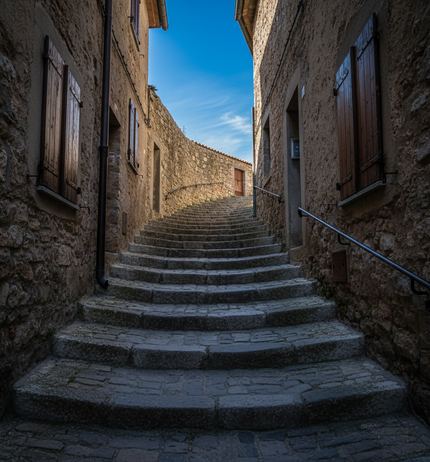
The Umbrian hill country
Italy · twelve nights instead of eight
from $2,890 two sharing one part changed -
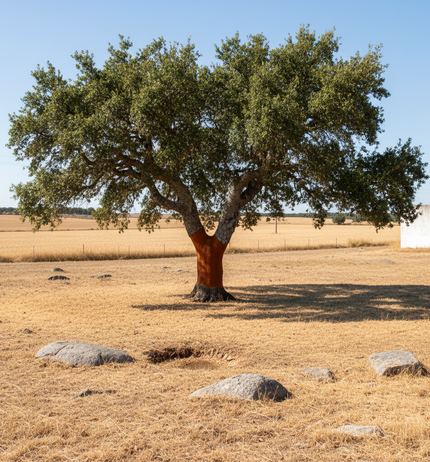
The Alentejo plain
Portugal · five nights instead of eight
from $1,690 two sharing one part changed -
The Jura plateau
France · deep winter instead of shoulder season
from $2,410 two sharing one part changed -
The Asturian coast road
Spain · four of you instead of two
from $2,180 two sharing one part changed -
Inland Arcadia
Greece · four hours from the airport, not two
from $2,260 two sharing one part changed -
The Welsh Marches
Wales · high summer instead of shoulder season
from $2,520 two sharing one part changed -
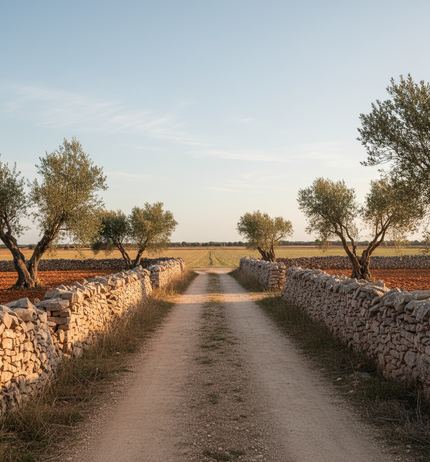
The heel of Puglia
Italy · one person instead of two
from $2,740 two sharing one part changed -
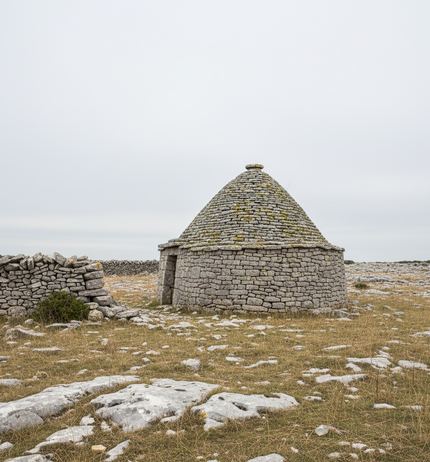
The Aveyron causses
France · sixteen nights instead of eight
from $3,880 two sharing one part changed -
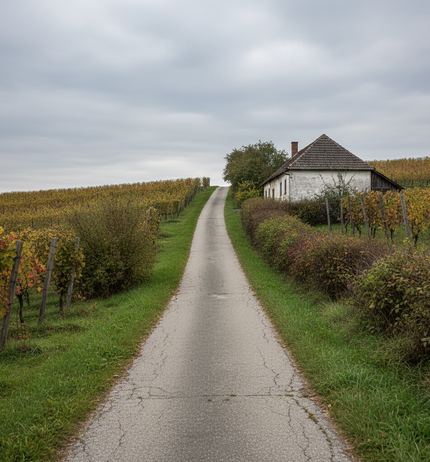
Eastern Slovenia and the Prekmurje
Slovenia · no car at all, trains and a bicycle
from $2,050 two sharing one part changed
Ask for this change in writing
Not a cent moves through here. The supplier bills you under its own name, and what this office earns reaches it from that supplier weeks later.